Refractive index and absorption from a THz-TDS measurement
How the standard thick-slab extraction works, what it assumes, and the four places it quietly gives you a wrong answer: etalons, phase unwrapping, the noise floor and thin samples.
THz-TDS transmission calculator
Everything described here, worked out in your browser. Nothing is uploaded.
What the measurement actually gives you
A terahertz time-domain spectrometer records an electric field against delay, not an intensity. That is the whole reason the technique can give you refractive index and absorption separately from a single pair of scans, where an intensity measurement can only ever give you one number per frequency.
Transform both scans and divide. The complex ratio of the sample spectrum to the reference spectrum carries amplitude in its modulus and phase in its argument. Everything the two scans have in common — the emitter, the detector, the optics, the water lines in the purge box — divides out. That cancellation is the measurement. It only holds if nothing else changed between the two scans, which is a stronger condition than it sounds.
The thick-slab extraction
For a slab of thickness d whose internal echo falls outside your time window, the phase gives the index directly. The sample delays the pulse by (n − 1)d/c relative to free space, so a measured phase difference Δφ at angular frequency ω means n = 1 + cΔφ/ωd. Nothing iterative, nothing fitted.
Amplitude gives absorption once the Fresnel losses are removed. Light entering and leaving the slab loses a fixed fraction at each surface, 4n/(n+1)² for the pair of them at normal incidence, and that fraction depends on the index you just extracted. What is left over is the absorption: α = −(2/d)·ln[T(n+1)²/4n], in amplitude terms, which is why the factor of two appears.
This is the standard extraction and it is entirely adequate for a millimetre of a moderately absorbing dielectric. It is not adequate for everything, and the rest of this note is about when it fails.
Where it goes wrong
The echo. If the internal reflection arrives inside your recorded window, the spectrum carries Fabry–Pérot ripple and the simple formula is wrong, because it assumes a single pass. Cutting the record before the echo removes the ripple at the cost of frequency resolution — you get Δf = 1/T and no more. Leaving the echo in keeps resolution and demands a proper iterative fit that models the reflections. Both are defensible. Doing neither, and reporting the simple formula on a rippled spectrum, is not.
Phase unwrapping. The arctangent that produces phase is bounded to 2π, so the phase you measure is the true phase modulo a whole number of cycles. Unwrapping walks along the frequency axis adding cycles wherever the phase jumps. It only works if the phase is sampled finely enough that the true change between adjacent points is less than π. Near the noise floor it is not, and a single bad jump propagates to every frequency above it. An index that drifts steadily upwards or downwards with frequency, when the material has no reason to disperse, is almost always a failed unwrap rather than a real dispersion.
The noise floor. Where the reference spectrum falls to within about 10 dB of the noise, the ratio is noise divided by noise. It will still plot as a smooth-looking curve. It means nothing. Any honest extraction has to state the frequency at which it stops, and the answer comes from the reference, not from how the result looks.
Thin samples. When the sample is thin enough that the echo cannot be separated in time at all, thickness and index become degenerate: a thinner, higher-index slab delays the pulse by the same amount as a thicker, lower-index one. You cannot get both from one measurement without either an independent thickness or a model that exploits the echo structure. If you only have the delay, you have one equation and two unknowns, and no amount of processing changes that.
A practical checklist
Measure the reference under the same purge and the same alignment as the sample, and as close in time as you can manage. Record long enough that you know where the echo is, then decide deliberately whether to keep it. Measure the thickness with a micrometer rather than trusting the fit — thickness error propagates straight into both n and α. Check that the extracted index is flat where the material should be non-dispersive. Finally, look at where your dynamic range runs out and do not quote a number above it.
Products mentioned
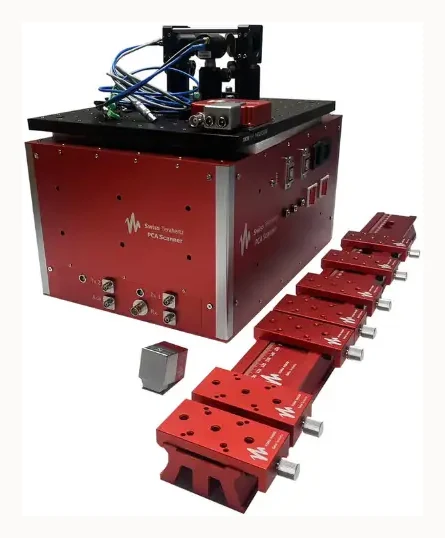
PCA Scanner