STFT Flat-Top THz Source
Swiss THz Flat Top Bullet Source
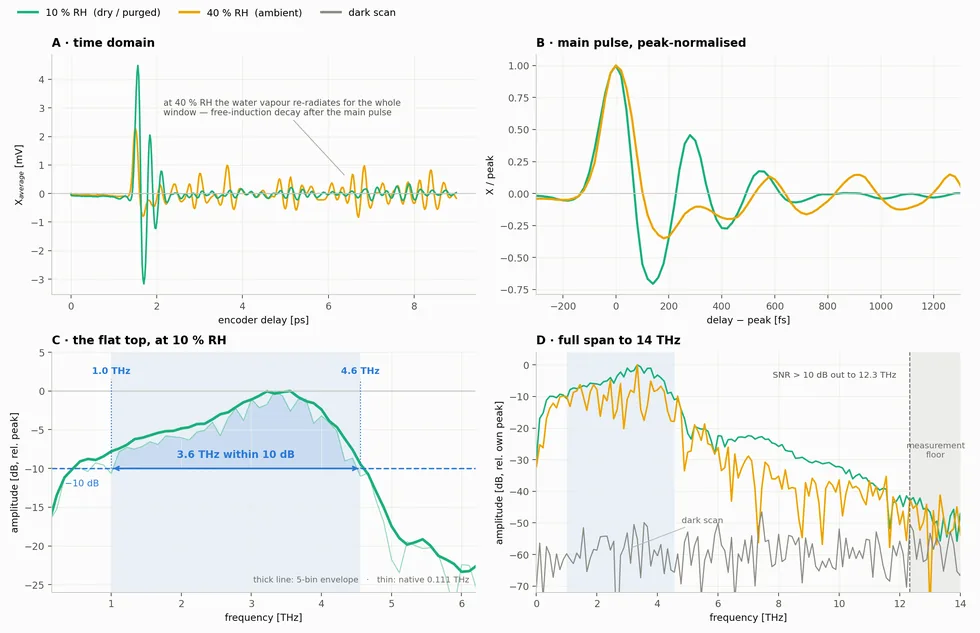
A terahertz source whose output stays within 10 dB of its peak right across the working band, instead of spiking at one frequency and falling away either side. The STFT flat top runs 1.0 to 4.6 THz — 3.6 THz wide, 2.2 octaves — and arrives in a single pulse. Above 10 MV/cm the pulse does not merely look at a sample, it drives it.
- Nonlinear terahertz spectroscopy
- Optical-pump terahertz-probe — photoconductivity, carrier lifetime, transient screening
- Terahertz-pump terahertz-probe — field-driven phase changes, saturation
- Terahertz-pump optical-probe — field-induced birefringence
- Ultrafast switching measurements, ≈ 1 ps resolution
- Terahertz imaging and non-destructive inspection
Lead time on request
Online prices are for budgetary purposes only. Exact prices can be up to 20% higher depending on the current exchange rate — please request a formal quotation.
Why the flat top matters — Most terahertz sources spike at one frequency and fall away either side, so a measurement is strong at the peak and noisy everywhere else. A flat top holds usable strength right across the band — one scan, even quality, no favoured colour.
Four configurations — Pump and probe can each be the terahertz pulse or the laser, and the bench is laid out so that all four pairings are reachable without rebuilding. The choice sets what you learn. The laser addresses electrons across the band gap; the terahertz field addresses what moves slowly — carriers, phonons, spins, bonds.
Two focus stations, either way round — Whichever configuration you run, the beams meet at one of two foci. Station 1 is the tight focus, smallest spot and strongest field, at 0.14 mm. Station 2 is the sample station, with more room around the sample, at 0.26 mm.
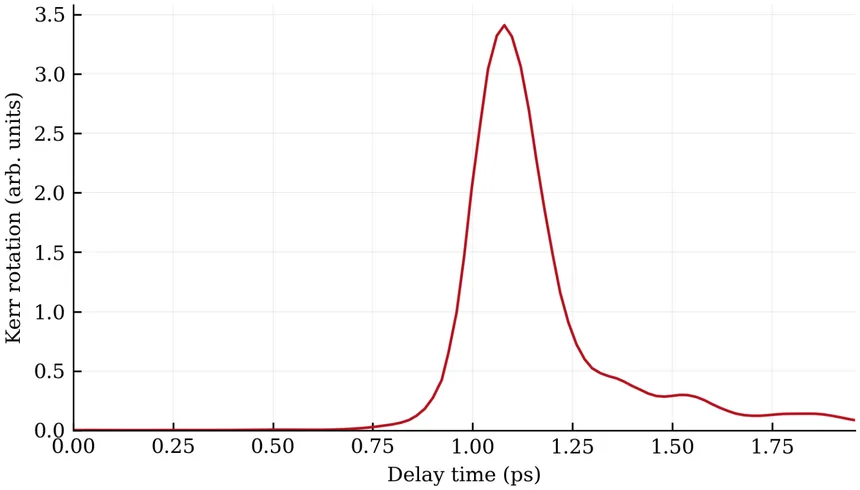
How the field is measured — A strong terahertz pulse briefly distorts a diamond crystal, and the height of the resulting Kerr rotation gives the field strength directly, with no power meter involved. The method has been checked against a completely independent calibration on another source and the two agreed to within about 8 %. For scale, 10 MV/cm is comparable to the field holding electrons to atoms, which is why the pulse can drive a material rather than just probe it.
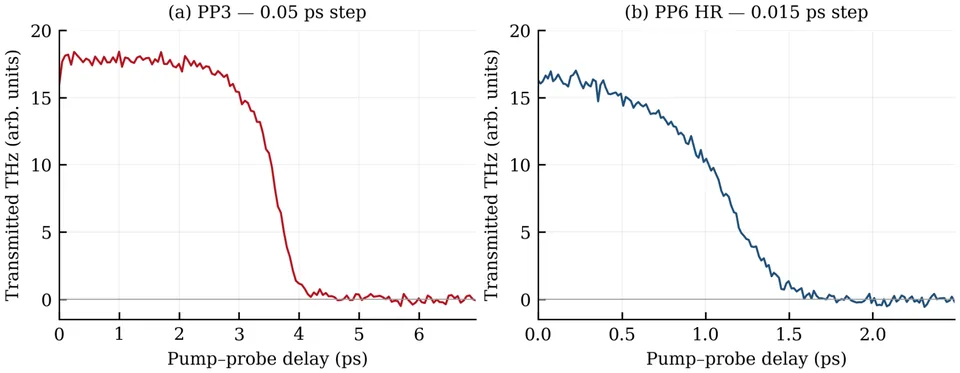
Watching electrons switch on — Sweeping the delay between the two pulses turns the horizontal axis into a clock. In a semiconductor turning conductive, the signal drops by more than 90 % as the electrons appear, and the edge is under a picosecond wide — fast enough to follow the switching itself, not just its aftermath.
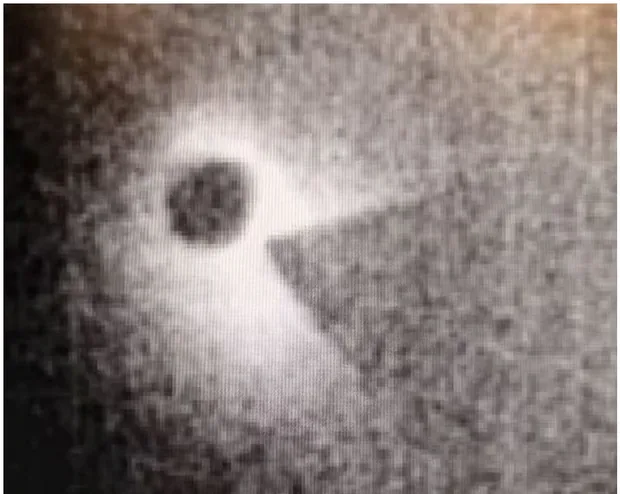
Seeing through things — Terahertz light passes through plastic, paper, ceramics and clothing but stops at metal and water, which makes it useful for looking inside sealed packages, coatings and composites without opening or damaging them. The STFT flat top helps here too — every frequency in the band arrives with usable signal, so contrast does not collapse away from one favoured colour.
- ▸ Values are from commissioning measurements on this system with the beam path in open air. Purging the path raises them. Full measurement records, methods and uncertainties are available on request.
- ▸ Water vapour absorbs terahertz light, which is why the beam path is normally purged.
| STFT flat-top band | 1.0 – 4.6 THz |
|---|---|
| Flat-top width | 2.2 octaves |
| Strongest at | 3.4 THz |
| Usable span | out to 12 THz |
| Peak electric field | > 10 MV/cm |
| Guaranteed floor | 8 MV/cm |
| Energy per pulse | 4 µJ |
| Conversion efficiency | 0.6 – 0.9 % |
| Pump pulse energy | ≈ 0.7 mJ |
| Driving laser | 1030 nm, ytterbium |
| Focus size, station 1 / 2 | 0.14 / 0.26 mm |
| Detection | Field, not power |
| Built-in cameras | Terahertz + laser |
| Delay range | Motorised, ps steps |
| Beam height | 135 mm |
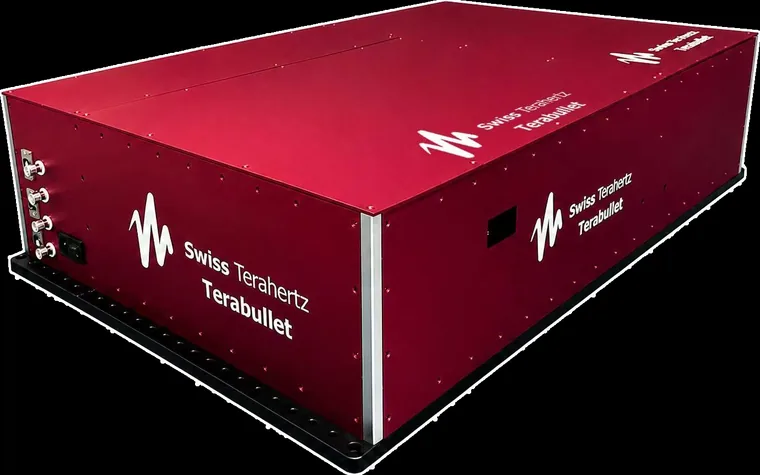
| Footprint | 120 × 90 cm (Terabullet enclosure) |
| Optical | Terahertz | A laser flash creates carriers; the terahertz pulse reads the conductivity that appears. Photoconductivity, carrier lifetime, transient screening. |
| Optical | Optical | Conventional transient absorption, using the two laser arms already on the bench. Population dynamics above the band gap. |
| Terahertz | Terahertz | The strong pulse drives the sample and a second terahertz pulse reads it. Nonlinear terahertz response, field-driven phase changes, saturation. |
| Terahertz | Optical | The terahertz field distorts the sample and the laser reads the induced birefringence. This is the route used for the field measurement. |
Pump and probe can each be the terahertz pulse or the laser, and all four pairings are reachable without rebuilding the bench.
| Signal change on switching | > 90 % |
| Time resolution | ≈ 1 ps |
| Finest delay step | 0.015 ps |
| Camera | Real time |
| Objective | f/0.7 |
| Feature size shown | 3 mm |