Uri Power Sensor
broadband THz power meter, flat 0.5–12 THz
A broadband pyroelectric power meter that resolves below 1 nW/√Hz. A lithium tantalate element with a black broadband absorber behind a silicon window responds to absorbed watts without regard to photon energy, so one calibration factor covers the whole flat band from 0.5 to 12 THz. The analog output is SMA or BNC, for a scope or a lock-in amplifier. A digital ADC output can be provided on request.
- Two different frequencies are involved — the chopping rate (10–15 Hz in normal use) and the frequency of the light being measured (0.1–20 THz). Every spectral figure here is quoted at a fixed 15 Hz chop.
- Inside the 0.5–12 THz plateau a single calibration factor is valid; no spectral correction is needed for a broadband source that fits inside it.
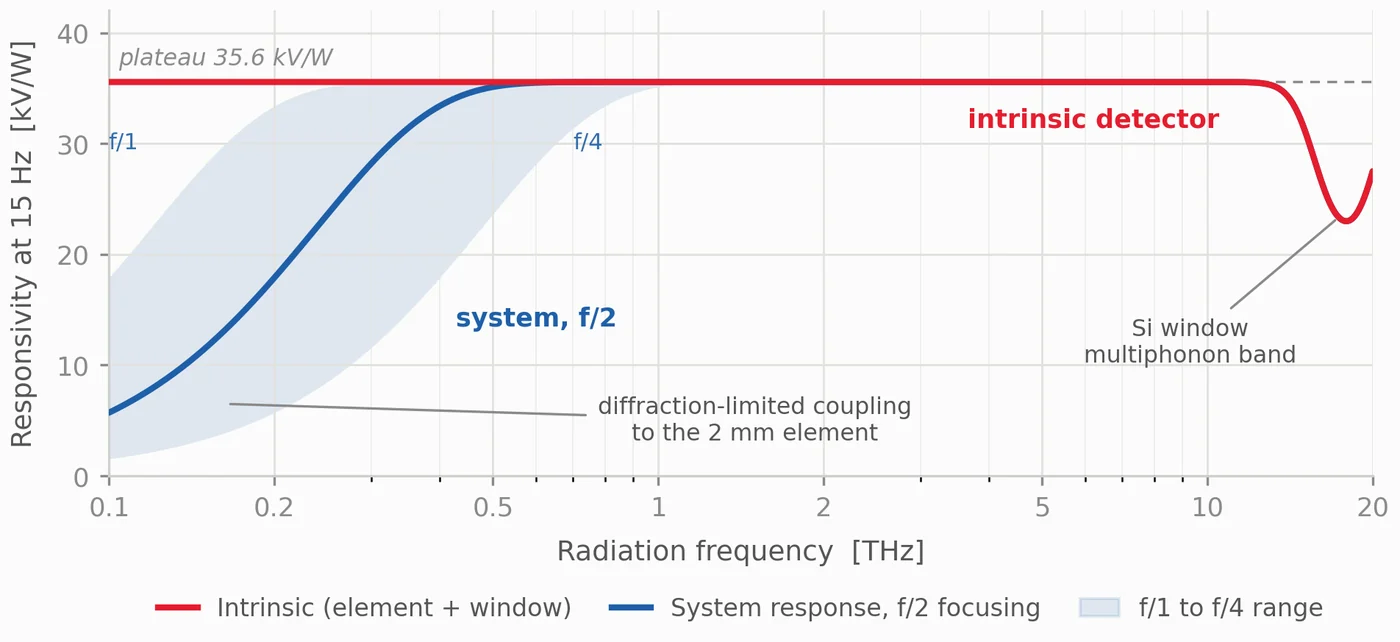
- The low-frequency limit is set by your focusing optics, not by the detector — tighter focusing recovers it.
- The 18 THz dip belongs to the silicon window and cannot be focused away.
- Analog output: SMA / BNC, to a scope or a lock-in amplifier.
- Digital output: ADC can be provided on request.
Lead time on request
Online prices are for budgetary purposes only. Exact prices can be up to 20% higher depending on the current exchange rate — please request a formal quotation.
A thermal detector, so a watt is a watt — The element does not care what photon delivered the energy, only that it was absorbed. That is why the response is flat over such a wide span, and why the shape of the curve is set entirely by what reaches the element and what fraction of it is absorbed, rather than by any property of the sensing material.
Two frequencies, not one — Confusing them is the most common misreading of a pyroelectric specification. The chopping frequency sets how fast the thermal signal is modulated; it is the axis of the relative-response table below, and the reason 85 kV/W at 10 Hz becomes 66 kV/W at 15 Hz. The radiation frequency is the colour of the light being measured, and is the axis of the spectral table. The two are unrelated.
Using the plateau — Between roughly 0.5 and 12 THz the response is constant to within a few percent. One number covers the whole span, which is what makes the head convenient for broadband sources. Outside that region there are two corrections and they behave differently: the low-frequency rolloff is recoverable by tighter focusing, the 18 THz window dip is not.
Focusing geometry has to be stated — The Uri2 element is 2.0 mm across behind a 5.0 mm aperture, and at 0.1 THz the wavelength is 3.0 mm, larger than the element itself. A low-frequency cutoff quoted without the focusing geometry means nothing: the same head reaches 0.15 THz with f/1 optics and only 0.6 THz with f/4. Uri8, with an 8 mm element, pushes that limit far lower.
Narrowband sources and the window — A plane-parallel window is a Fabry–Pérot etalon. A broadband source averages over many fringes and sees the incoherent transmission of 0.539; a coherent narrowband source can land anywhere between 0.29 and 1.00 as it sweeps across the 88 GHz fringe spacing. For narrowband work the window transmission is not a single number.
- ▸ Spectral and windowed responsivity figures are calculated for the 2 × 2 mm element behind the standard silicon window at 15 Hz chopping. The 85 kV/W headline is the windowless value at 10 Hz against a 500 K blackbody.
- ▸ Geometric coupling is a property of the interface between your beam and the element, not of the detector. The cutoffs tabulated below assume a diffraction-limited focus onto the 2 mm element.
- ▸ The window is modelled as plain high-resistivity silicon, 0.5 mm nominal. An antireflection coating or an infrared bandpass in its place changes every absolute figure.
Choose your specification — the model number and price appear immediately.
| Sensitivity | < 1 nW/sq(Hz) |
|---|---|
| Analog output | SMA / BNC |
| Digital output | ADC upon request |
| Sensor aperture | Uri2: 2 mm × 2 mm · Uri8: 8 mm × 8 mm |
| Spectral sensitivity | 0.1 to 350 THz (element) · 0.1 to 20 THz windowed |
| Flat band | 0.5 to 12 THz, within a few % |
| Sensitive element | Lithium Tantalate + black absorber |
| Window | Silicon, high-resistivity float zone |
| Entrance aperture | 5.0 mm diameter (Uri2) |
| Responsivity | 85 kV/W at 10 Hz, windowless · 35.6 kV/W at 15 Hz, windowed |
| NEP (10 Hz) | < 1 nW/√Hz |
| Thermal time constant | 150 ms |
| Supply voltage | Two batteries |
| Operating temperature | −20 to 80 °C |
| Output | SMA |
| Modulation | Optional shutter |
| Detector type | Pyroelectric, current mode |
| Pyroelectric material | Lithium tantalate (LiTaO₃) |
| Active area | 2.0 × 2.0 mm (Uri2) · 8.0 × 8.0 mm (Uri8) |
| Absorbing layer | Black broadband coating |
| Entrance aperture | 5.0 mm diameter (Uri2) |
| Feedback resistor | 100 GΩ |
| Feedback capacitor | 0.2 pF |
| Thermal time constant | 150 ms (1.06 Hz) |
| Electrical time constant | 20 ms (7.96 Hz) |
| 1 Hz | 65 % | 79.7 | 43.0 |
| 2.9 Hz (peak) | 100 % | 122.3 | 65.9 |
| 3 Hz | 93 % | 114.2 | 61.6 |
| 7 Hz | 82 % | 100.0 | 53.9 |
| 10 Hz | 70 % | 85.0 | 45.8 |
| 15 Hz | 54 % | 65.9 | 35.5 |
| 20 Hz | 43 % | 53.1 | 28.6 |
| 50 Hz | 19 % | 23.4 | 12.6 |
| 100 Hz | 9 % | 11.5 | 6.2 |
Relative response is normalised to its own peak, which falls at 2.9 Hz between the thermal and electrical poles. Below 1 Hz the response rises linearly; above 8 Hz it falls as 1/f. Windowed values include the silicon window.
| 0.1 THz | 3.00 mm | 0.539 | 0.16 | 35.6 | 5.7 |
| 0.2 THz | 1.50 mm | 0.539 | 0.50 | 35.6 | 17.9 |
| 0.3 THz | 1.00 mm | 0.539 | 0.79 | 35.6 | 28.2 |
| 0.5 THz | 0.60 mm | 0.539 | 0.99 | 35.6 | 35.1 |
| 1.0 THz | 0.30 mm | 0.539 | 1.00 | 35.6 | 35.6 |
| 2.0 THz | 0.15 mm | 0.539 | 1.00 | 35.6 | 35.6 |
| 5.0 THz | 0.060 mm | 0.539 | 1.00 | 35.6 | 35.6 |
| 10 THz | 0.030 mm | 0.539 | 1.00 | 35.6 | 35.6 |
| 15 THz | 0.020 mm | 0.476 | 1.00 | 31.4 | 31.4 |
| 18 THz | 0.017 mm | 0.349 | 1.00 | 23.0 | 23.0 |
| 20 THz | 0.015 mm | 0.417 | 1.00 | 27.5 | 27.5 |
At 15 Hz chopping, through the silicon window. The intrinsic column is the element plus window; the f/2 column additionally includes coupling of a diffraction-limited focus onto the 2 mm element.
| f/1 | 0.15 THz |
| f/2 | 0.3 THz |
| f/4 | 0.6 THz |
For the 2 mm Uri2 element, taking the focus as a diffraction-limited Gaussian. This is a property of your optics, not of the head.
| Material | Silicon, high-resistivity float zone |
| Refractive index | n = 3.42 |
| Thickness | 0.5 mm nominal |
| Transmission, broadband, below 10 THz | 0.539 (R = 0.300) |
| Etalon fringe spacing | ≈ 88 GHz |
| Transmission across one fringe | 0.29 to 1.00 |
| Multiphonon band | ≈ 610 cm⁻¹ (18.3 THz), α ≈ 8 cm⁻¹ |
| Transmission at band centre | ≈ 0.36 |
| 14041 | Uri2 | 200 |
| 14042 | Uri8 | 650 |
| 14043 | Uri2 OEM | 100 |
| 14047 | SMA to BNC converter | 20 |
| 14051 | Modulation shutter | Contact |
| 17011 | Avery DAQ (ADC + software) | 250 |
| 17032 | Avery DAQ (ADC + software) OEM | 130 |
Rigi Camera
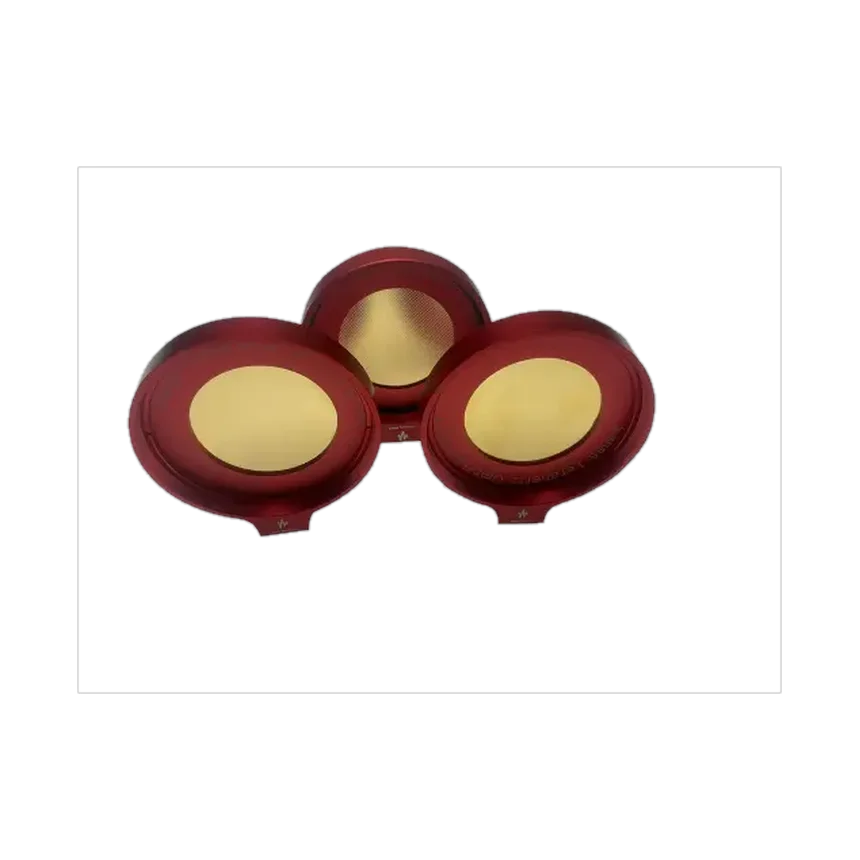
Terahertz Filters
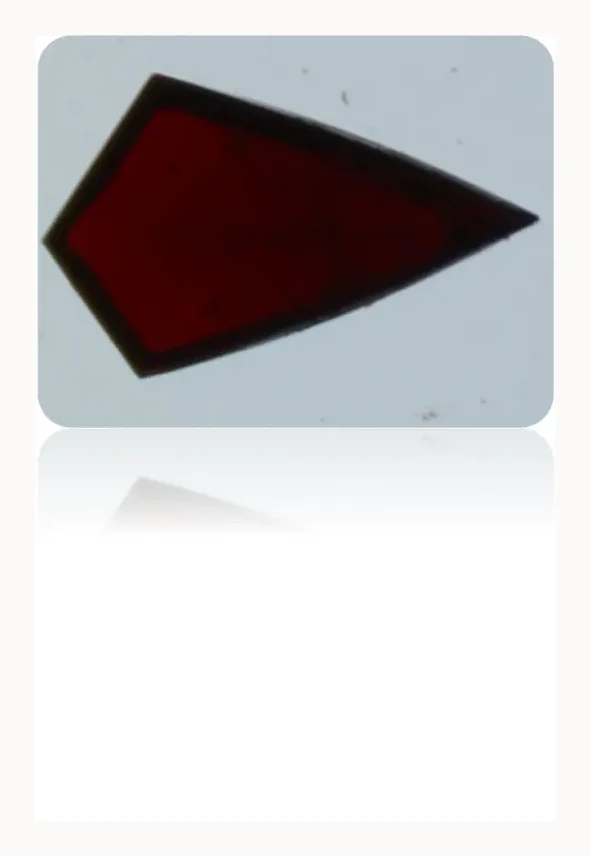
Organic Crystals (Emitters)