Choosing an electro-optic crystal for a target bandwidth
GaP, ZnTe, GaSe and BBO compared honestly. Why velocity mismatch, not material quality, sets your detection bandwidth, and why a thinner crystal is usually the right answer.
Electro-optic sampling bandwidth calculator
Everything described here, worked out in your browser. Nothing is uploaded.
The bandwidth is set by a race, not by the material
Electro-optic sampling works because the terahertz field rotates the polarisation of a much shorter optical probe pulse as the two travel together through a crystal. The measurement is only faithful if they travel together. The probe moves at the optical group velocity; the terahertz moves at its own phase velocity, which in general is different. They drift apart as they go.
Once they have drifted by half a terahertz cycle, the second half of the crystal is undoing what the first half did. That sets a coherence length, and it shrinks as the terahertz frequency rises — which is why a crystal that works beautifully at 1 THz is deaf at 5. Nothing about crystal quality changes this. It is kinematics.
What that means for thickness
A thicker crystal gives more signal, up to the coherence length, and less bandwidth. A thinner crystal gives less signal and more bandwidth. There is no setting that gives both, and any vendor claim that implies otherwise is describing a different measurement.
The useful way to think about it: pick the highest frequency you actually need, find the thickness whose coherence length reaches it, and accept the signal that gives you. Then recover signal by averaging, not by thickening. Averaging costs time; thickening costs bandwidth you cannot get back in processing.
The four common crystals
ZnTe is velocity matched near 800 nm, which is why it became standard on Ti:sapphire benches. It has a phonon at 5.3 THz that ends the band abruptly, and it two-photon absorbs at 800 nm, which limits how hard you can probe.
GaP is matched nearer 1 µm and has its phonon much higher, around 11 THz, so it reaches further even though its electro-optic coefficient is smaller than ZnTe's. On a 1030 nm or 1550 nm fibre system it is usually the right first choice.
GaSe is used where the band has to extend well past 10 THz. It is birefringent and must be angle tuned, which makes it fiddly, and it cleaves easily. In exchange it can be phase matched over a wide range.
BBO has a very small electro-optic coefficient and is only sensible where extreme bandwidth matters more than signal, typically with very short probe pulses.
The probe pulse is the other limit
Whatever the crystal does, a probe pulse of duration τ cannot resolve features faster than τ. The measured response is the true field convolved with the probe envelope, which rolls off the high frequencies exactly as a low-pass filter would. A 100 fs probe caps you near 5 THz no matter what crystal it passes through. If you have optimised the crystal and the band still ends where it did, the probe is your limit.
This part, unlike the velocity mismatch, is partially recoverable. The crystal response is a known function of thickness, probe duration and wavelength, so a measured waveform can be corrected for it by deconvolution — within the dynamic range you have, and no further.
Products mentioned
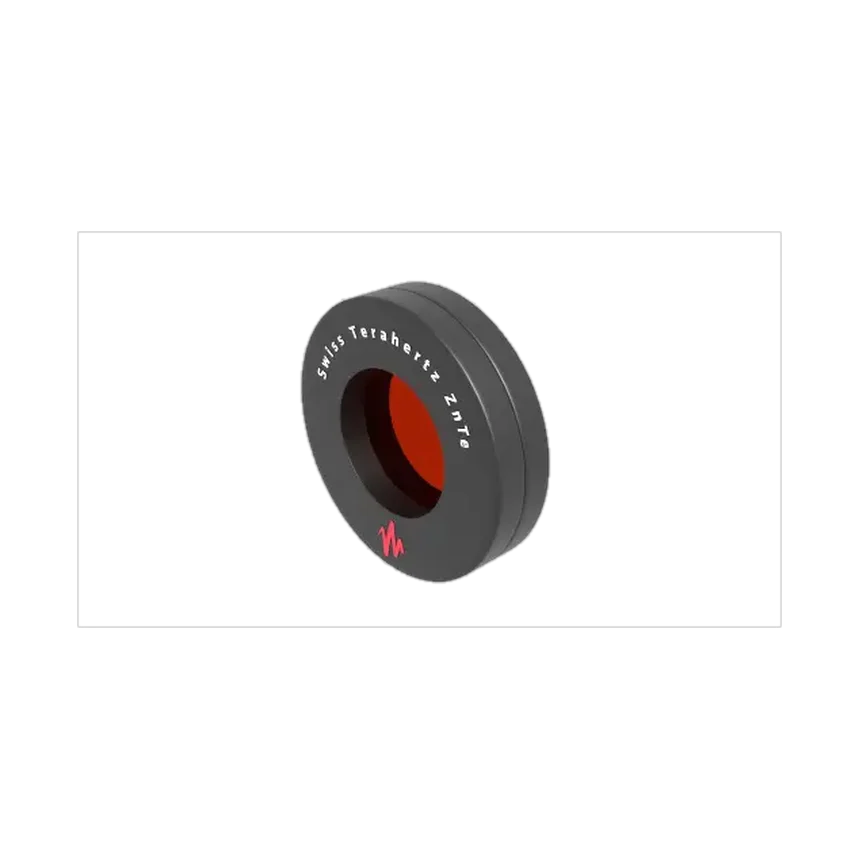
THz Detector Crystals