Organic crystal thickness: why thicker stops helping
DAST, DSTMS, OH1 and BNA. Coherence length, terahertz absorption and pump absorption each cap the useful thickness, and the third one is the one most often left out.
Organic crystal phase matching calculator
Everything described here, worked out in your browser. Nothing is uploaded.
Three limits, not one
Optical rectification in an organic crystal converts a short pump pulse into a terahertz transient. The obvious intuition — a longer crystal converts more — is right only over the first few tens of microns. Three separate effects then take over, and which one bites first depends on the crystal and on the frequency you care about.
Velocity mismatch. The pump travels at its optical group index, the terahertz at its own index. When the two agree, every slice of crystal adds in phase and output grows with the square of thickness. When they disagree, output oscillates with thickness instead of growing, and past the coherence length a thicker crystal gives you less. Each of the common organic crystals is matched at a particular pump wavelength — near 1500 nm for DAST and DSTMS, 1300 nm for OH1, 800 nm for BNA — and the mismatch opens up as you move away from it.
Terahertz absorption. What the front of the crystal generates has to get out through the back. Organic crystals have a strong lattice phonon and a non-resonant background that rises roughly as the square of frequency, so the high end of the band is absorbed hardest. Even under perfect phase matching, output saturates once the crystal is a few absorption lengths thick.
Pump absorption. This is the one most often left out, and it is usually what pulls the practical optimum down to a few hundred microns. The pump is attenuated on its way in, so the source term driving the conversion gets weaker with depth. Without it, a model predicts an optimum thickness that saturates gently; with it, the curve has a genuine maximum and then falls.
What the phonon does to phase matching
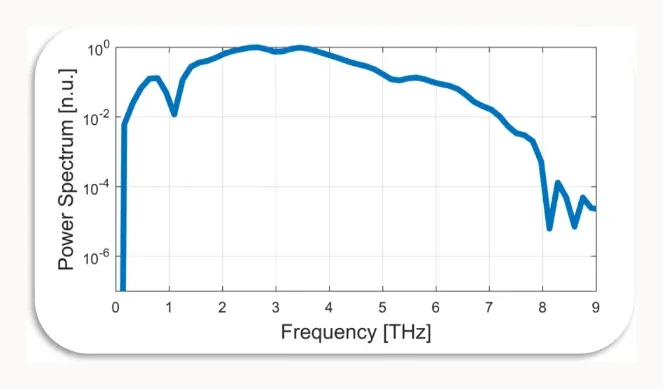
A lattice resonance does two things at once. It absorbs strongly at its own frequency, which is obvious, and it drags the refractive index around on either side of it, which is not. The consequence is that phase matching which holds comfortably below the phonon can fail above it, even though nothing about your pump changed. If your spectrum has a hole and a shoulder rather than a smooth roll-off, the phonon is the first thing to suspect.
Numbers you should not take from a datasheet
Refractive indices for these materials are published and reasonably consistent between groups. Absorption coefficients are not: they are usually presented as plotted curves rather than tabulated numbers, they vary with crystal axis, temperature and growth batch, and the values that circulate are often placeholders inherited from an earlier paper.
Treat any absorption figure you did not measure as an order of magnitude. If you have measured your own crystal at one or two frequencies, put those numbers in and everything downstream improves with them. Two-photon and free-carrier absorption are a separate matter again — they depend on how hard you pump rather than on a fixed coefficient, so they cannot be folded into a single number at all.
Products mentioned
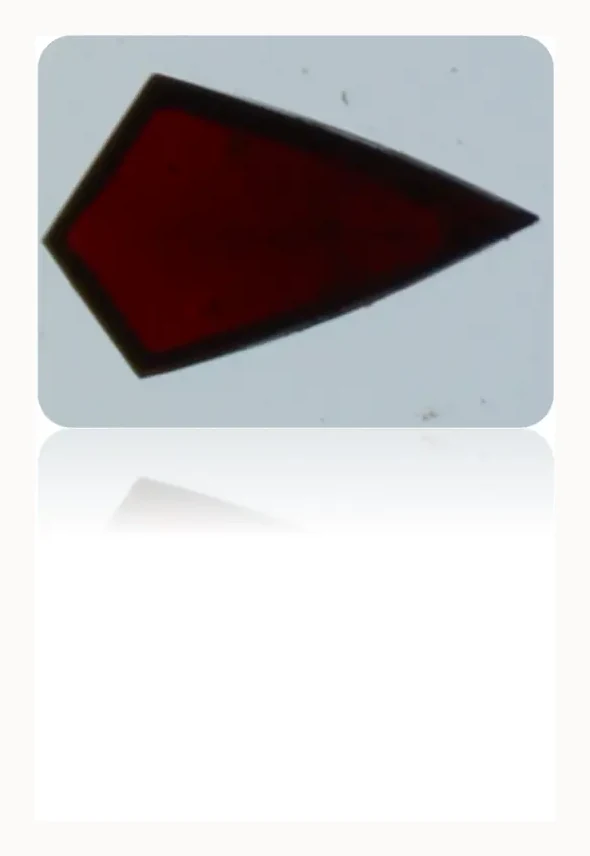
Organic Crystals (Emitters)
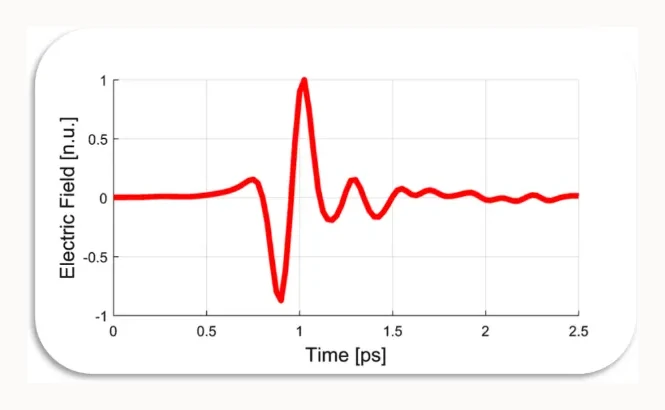
DAST Organic Crystal
DSTMS Organic Crystal