
Calculadoras THz
Five analysis tools and four conversions that come up in every terahertz experiment. Everything runs in your browser; nothing is sent anywhere.
Análisis de espesor
Arrastre un barrido en el dominio del tiempo y lea el espesor y el índice de refracción de la muestra. Donde el eco interno se resuelve, ambos se obtienen a la vez: sin índice supuesto y sin muestra de calibración. Funciona en el navegador; no se envía nada a ningún sitio.
Abrir la herramienta →Análisis de espesor de pintura
Cada capa de un sistema de pintura de automoción a partir de un barrido en reflexión: barniz, base, imprimación, cataforesis. Sus ecos se solapan dentro del pulso, así que se ajusta toda la forma de onda a la vez. Le dice qué capas hay realmente.
Abrir la herramienta →Terahertz transmission
A reference scan and a sample scan in, transmission out. Both transformed, the spectra drawn against the noise floor so you can see where the data ends, and refractive index and absorption from a thickness. Linear, per cent, log or dB.
Abrir la herramienta →Organic crystal phase matching
What thickness of DAST, DSTMS, OH1 or BNA gives the most terahertz, and where the band ends. Coherence length, the phonon, and output against thickness, from indices you can replace with your own measurements.
Abrir la herramienta →Ancho de banda de detección EO
Cuánto ancho de banda ofrece realmente un detector electroóptico de GaP o ZnTe. Elija cristal, espesor, longitud de onda de sonda y duración de pulso; la curva muestra dónde le cortan el desajuste de velocidad y el fonón.
Abrir la herramienta →Conversor de unidades espectrales
Rango de barrido TDS ↔ resolución
La resolución en frecuencia la fija la longitud de la traza temporal: Δf = 1/T.
PCA Scanner: 600 ps / < 2 GHz básico, 3 ns / < 0.5 GHz opcional.
Foco limitado por difracción
d = 1.22 λ f / D.
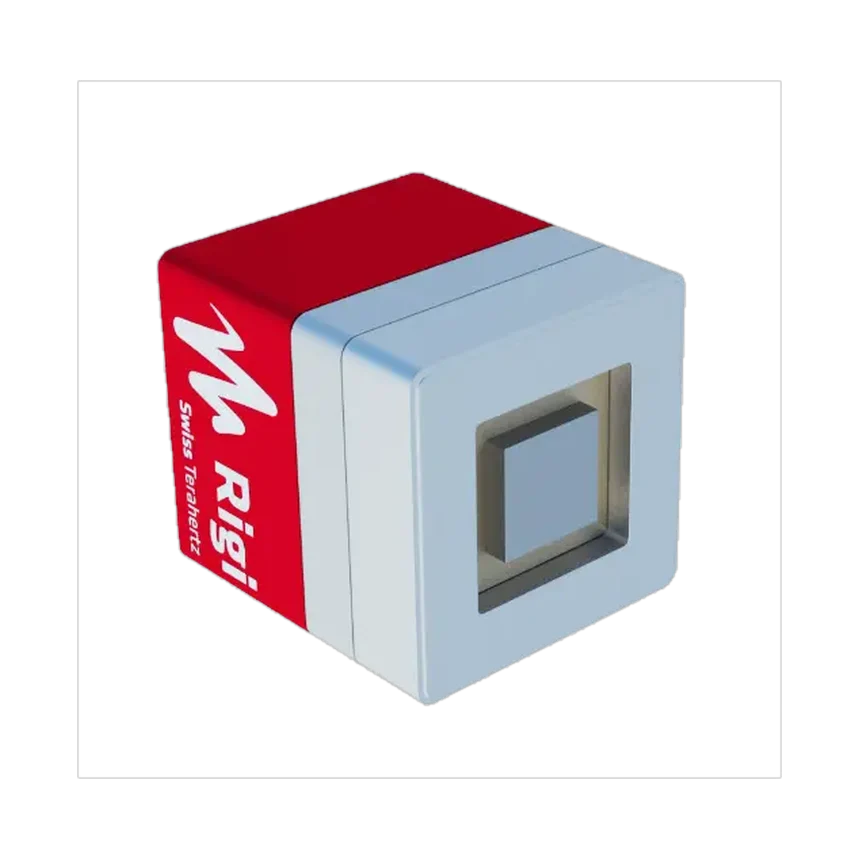
Campo de visión RIGI
Área activa de la matriz del plano focal, antes del objetivo.
Notas de aplicación
What these tools are doing, and where each method quietly gives a wrong answer.
Refractive index and absorption from a THz-TDS measurement
How the standard thick-slab extraction works, what it assumes, and the four places it quietly gives you a wrong answer: etalons, phase unwrapping.
Read it →Choosing an electro-optic crystal for a target bandwidth
GaP, ZnTe, GaSe and BBO compared honestly. Why velocity mismatch, not material quality, sets your detection bandwidth.
Read it →Organic crystal thickness: why thicker stops helping
DAST, DSTMS, OH1 and BNA. Coherence length, terahertz absorption and pump absorption each cap the useful thickness.
Read it →Dynamic range, and where your data stops being data
Bandwidth claims mean nothing without a dynamic range to go with them. How to measure the noise floor honestly.
Read it →Water vapour lines and what they do to a transmission spectrum
Why atmospheric absorption lines throw spikes into a transmission ratio, why purging is the real fix.
Read it →